
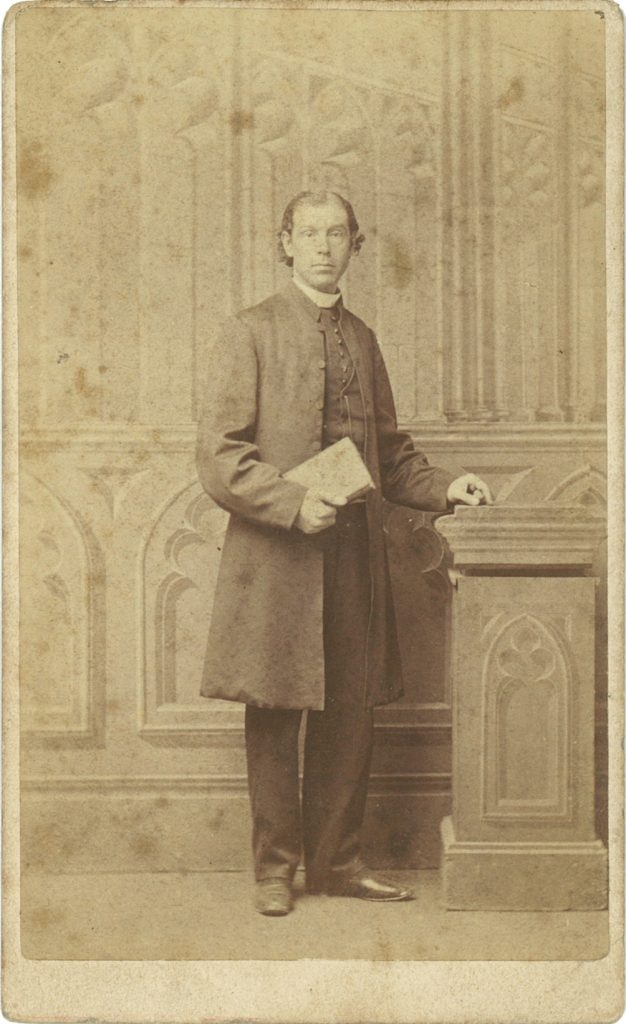
World Poetry Day is observed every year on 21 March. Declared by UNESCO in 1999, this day celebrates the enduring power of poetry as a universal form of human expression.
What is poetry? To quote William Wordsworth, “Poetry is the spontaneous overflow of powerful feelings: it takes its origin from emotion recollected in tranquillity”. [1]
Such a definition describes Father Julian Tenison Woods as a poet. As a child, he gained a love for the arts from his mother and shared her enthusiasm for reading and writing poetry. [2]
Poetry takes many forms and much of Fr Julian’s prose is poetic in nature e.g.
The flowers unveil the hidden secrets of their beauty;
The stones reveal their crystalline structure
And the tiniest insects display wonders of mechanism.
Julian Tenison Woods, From Notes made in North Australia, Sydney Mail, 17 July 1880
However, he did consciously slow down and express his emotions in simple lines of poetry and hymns, such as found in a book published in 1890.[3] The pages in this little book reveal how Fr Julian’s prayer time flowed into creative writing. There are a number of poems/songs devoted to Mary, Mother of God. The language is that of a son grateful for his heavenly Mother, sympathising with her pain and longing to be with her. Perhaps reminiscent of the loss of his own mother when he was only 15?
There are also poems/songs to the Sacred Heart and reflections on Jesus and the Way of the Cross. Perhaps writing poetry was a way of dealing with the suffering and rejection he felt throughout his life e.g.
Yes amid all my crosses,
The hardest to bear
Are the fears and reproaches
Of those who would share
My love for my Mother,
My faith in Her Name,
But in darkness and doubt
Think me only to blame.
From I’ll Trust to My Mother written at Hobarton, Feast of Sacred Heart, (4 June) 1875
Fr Julian’s poetry also reveals a longing for death, not as a morbid preoccupation but as a way to finally be united with his God. One poem on this theme gives one pause for reflection:
An Ode to Death
Call it not death. Evening has come
But day shines on a distant shore,
The sun’s bright glory still goes on,
For evermore.
Call it not sleep. True life begins
When eyelids close nor heaves the breast,
The tired soul the conquest winds,
And endless rest.
Yet call it death. Yes death to grief.
And pain and sorrow, strife and tears,
All, all will seem now less than brief,
‘Mid endless years.
Yet call it sleep. Life’s fever o’er,
Like children sink we down to rest,
And dream real dreams for evermore,
Amid the blest.
No, call it life. All else is death,
From this sad clay of death we’re freed,
Say only we resign our breath
To live indeed.
Come then sweet life, whom men call death,
Come joy, whom earthly men call pain,
Come breathing life and take my breath,
And break my chain.
I long to live, I long to die,
I pine to quit this earthly clod,
Give me an angel’s wing to fly,
And be with God.
An Ode to Death written at Honeywood, 8 March 1876
During his time as parish priest of Penola, Fr Julian met and became friends with Adam Lindsay Gordon, arguably one of Australia’s finest poets. They discovered they shared a love of poetry and poets and from their first meeting over supper at a cattle station in 1857, they often rode together reciting poetry they knew by heart. What an enjoyable and invigorating way to pass the time!
Poetry was an integral part of Fr Julian – it flowed from his prayer and spirituality and embellished his essays and descriptions of the environment. In a harsh and unforgiving new land, poetry was a refuge and an expression of his deepest self.
Carmel Jones rsj
[1] From the Preface to Lyrical Ballads, an essay composed by William Wordsworth for the second edition published in 1800 of the poetry collection, Lyrical Ballads.
[2] Isabel Hepburn in No Ordinary Man (1979) tells that Mrs Woods’ favourite poet was William Cowper and that Julian learnt many poems by Scott, Moore, Dryden and Pope by heart as well as being encouraged to write his own.
[3] Hymns and Sacred Poems by Father Julian E Tenison Woods, compiled in Alvernia, Sydney in 1890. Accessed from the Tasmanian Archives of the Sisters of Saint Joseph.