
Although World War II ended in 1945, global instability remained. The wartime alliance between the United States, Great Britain, and the Soviet Union quickly collapsed amid deep ideological mistrust, giving rise to the Cold War. While Western nations promoted capitalism and liberal democracy, the USSR sought to expand Marxist, atheistic communism, heightening fears of a global ‘domino effect’, particularly after developments in China and North Korea. Within a decade of the war’s end, rival military and political alliances had formed to contain further expansion. The ideological tensions of this period also had domestic consequences, including the split of the Australian Labor Party in 1955.
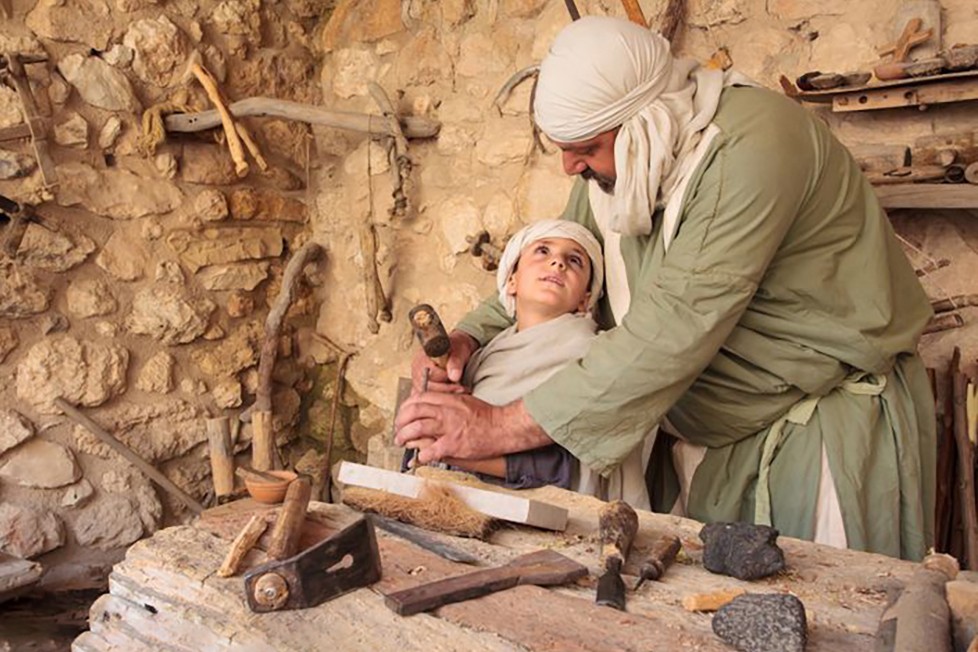
It was against this backdrop of suspicion and ideological conflict that Pope Pius XII instituted the feast of St Joseph the Worker on 1 May 1955. His intention was to articulate a distinctly Christian vision of labour and to challenge secular and Marxist interpretations of work commonly associated with International Workers’ Day, or ‘May Day’. At that time, the USSR had positioned itself as the champion of the working class, using May Day celebrations to glorify communism and display its military strength.
In response, Pope Pius XII deliberately held up St Joseph the Worker as a model for all who follow Christ. Since the time of Pope Leo XIII in the nineteenth century, Catholic social teaching had emphasised that work is a fundamental aspect of human existence: ‘God took the man and put him in the Garden of Eden to work it and take care of it’ (Gen 2:15). Created in the image of God, human beings possess an innate dignity denying exploitation by state or institution.
The evangelists Matthew and Luke describe Joseph as a tekton – one who works with hard materials. Through his labour, Joseph provided for his family, thereby enabling God’s saving mission to unfold. His work honoured God, served others, and became the means of his own sanctification. In contrast to materialistic philosophies, St Joseph the Worker reminds us that work is not merely economic activity but a vocation: a call through which human beings collaborate with the ongoing work of the Creator, grow in holiness, fulfil their God‑given potential, and contribute to society.
Accordingly, Church teaching insists that remuneration should enable workers to secure a dignified livelihood for themselves and their families. Just relationships between governments, employers, and workers recognise that a just wage is the legitimate fruit of labour, and its denial is considered a grave injustice (Catechism, §2434). Joseph, revered as the Just Man, exemplified right relationship – justice – toward both God and neighbour. His quiet fidelity reminds us that, regardless of social status, all people are owed respect, dignity, and fair treatment.
The social and political conditions confronting Pope Pius XII led him to invoke St Joseph as patron of workers, a legacy that remains relevant for today’s Church and world:
There could not be a better protector to help you penetrate the spirit of the Gospel into your life… Therefore, if you would be close to Christ, we once more repeat today: Ite ad Ioseph – Go to Joseph!
Mary Cresp rsj