
There is an anonymous nursey rhyme dating from 1838 naming characteristics of children born on particular days. Julian’s a ‘Thursday child – has far to go’. The traditional interpretation suggests he will have a long, successful life. [1]
Although Julian was only 57 when he died, he certainly achieved success in many fields. Julian Edmund Tenison Woods was the fourth son and sixth child born to Henrietta Marie St Eloy (née Tenison) and James Dominick Woods, on Thursday, 15 November 1832 at 13 West Square Southwark, London.
Julian’s father, who was a reporter for the London newspaper, The Times, was not present when Julian was born. He was reporting on the German siege of the city of Antwerp in Belgium. When he returned, Julian was four months old. Imagine the joy of Henrietta to see father and son together.
Following the Catholic tradition of his father, Julian was baptised in February 1833 by Father John White of St George’s Cathedral, Southwark in London. His mother, coming from the Tenison family, “was strong in its Anglican tradition, dating from Elizabethan times, counting an Archbishop of Canterbury and a Bishop of Ossory among their number”. [2] Henrietta chose the name Tenison honouring her family ancestry. [3] Julian fondly recalls his birthday as being the feast of St Gertrude the Great – a 13th century Benedictine, mystic and theologian and acknowledges that his love of the Sacred Heart came from her.
Reflecting on the specific year of Julian’s birth we find some notable characters. Among them is Charles Lutwidge Dodgson, English author, poet, mathematician, photographer, and Anglican deacon, better known by his pen name Lewis Carroll (27 January); the French modernist painter, Édouard Manet (23 January) one of the first 19th century artists to paint modern life and a pivotal figure in the movement from realism to impressionism; and the German composer, pianist, and conductor Johannes Brahms (7 May) born to share beautiful music. We also find the American novelist and poet, a couple of weeks younger than Julian, Louisa May Alcott (29 November) providing the world with amazing stories to entertain us. [4] Maybe this creative milieu was the fertile climate out of which Julian developed his own gifts.
World events at the time of Julian’s birth, included the First Industrial Revolution. British political history introduced the Great Reform Act of 1832, restructuring the electoral system. These two events caused great suffering in many aspects of life and led to women being disenfranchised. The Church of England, fearing that the ‘secular’ state was seizing God’s authority, caused John Henry Newman, the 19th century English theologian and Anglican priest, to form the Oxford Movement in order to restore early Christian and Catholic traditions with Anglicanism. [5] It was around this time that the words ‘social justice’ came to the fore.
There was much more happening in this world that Julian was born into than this space allows to elaborate. Julian had the privilege of growing up in a lively affectionate household where intelligent conversation was normal, natural talents nurtured, literary, scientific and musical skills freely developed.
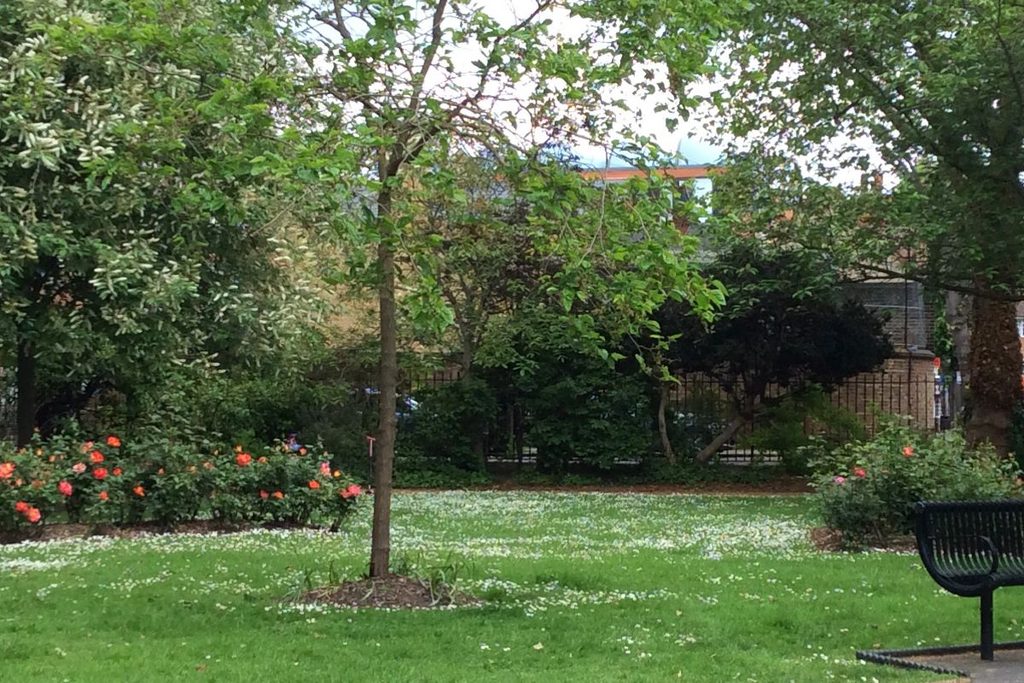
In his Memoirs, Julian fondly recalls his home in West Square: “It has a large enclosure or garden in the middle, with beautiful flowers in the spring and summer.” [6] It is so easy when visiting this place to imagine Julian and his brothers at play here, amongst the flowers and the squirrels; knowing he would have explored every nook and cranny, becoming lost in the wonder of nature and beauty.
Let us give thanks for Julian’s many gifts as we celebrate this Thursday Child, whose influence continues to touch our lives.
Ann Morrison rsj
[1] https://allpoetry.com/poem/17065800-Thursday-s-Child-Has-Far-to-Go-by-Deborahlee
[2] 1979,1994 Margaret Press RSJ, Julian Tenison Woods: Father Founder, Collins Dove, Victoria Australia, p. 6
[3] Ibid p. 16
[4] https://www.onthisday.com/birthdays/date/1832
[5] https://www.britannica.com/biography/Saint-John-Henry-Newman
[6] 1979,1994 Margaret Press RSJ, Julian Tenison Woods: Father Founder, Collins Dove, Victoria Australia, p. 7