
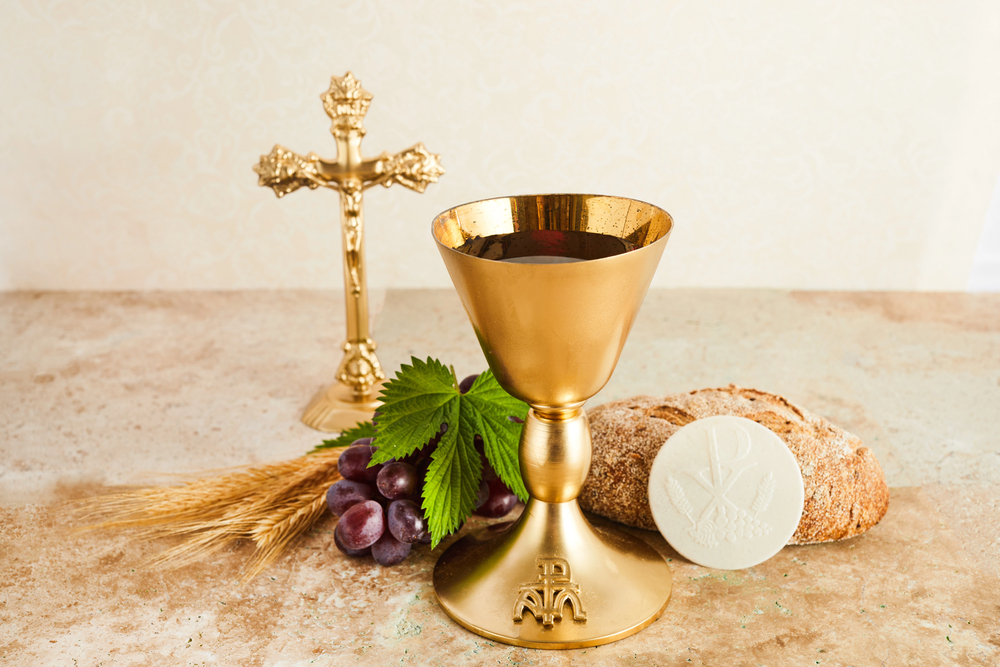
Corpus Christi (Latin), Body of Christ, Blessed Sacrament, Holy Communion, Eucharist – all relate to the real Presence of Jesus among us.
“The mystery of the Eucharist is the true centre of the sacred liturgy and indeed of the whole Christian life. Consequently, the Church, guided by the Holy Spirit, continually seeks to understand and to live the Eucharist more fully”. [1] “The sacrifice and sacred meal belong to the same mystery …” [2]
The Catechism of the Catholic Church states: “Eucharist makes present the one sacrifice of Christ…” [3] “It is called Eucharist because it is an action of thanksgiving to God.” [4]
Saint Mary MacKillop wrote very little about Eucharist, but her devotion was profound. She referred often in letters to ‘hearing Mass’ and of ‘receiving our dear Lord’, [5] almost as separate experiences. Many Catholics of her generation received Communion only a few times annually, as the laity’s role was mainly to adore and worship the Eucharist, [6] until Pope Pius X, in 1910, exhorted all to receive Communion frequently.
The manner of celebrating Eucharist changed with Vatican II (1962-1965) from the passive participation that Mary MacKillop experienced to full and active participation that we encounter today. Whilst celebrating this ‘Mystery of Faith’ we profess: “When we eat this Bread and drink this Cup, we proclaim your death O Lord…” [7] We need to be fully involved!
Sisters’ memories of Mary were that she spent long hours daily in prayer before the Blessed Sacrament, especially before retiring. One Sister wrote: What “struck me mostly …was her love for Our Lord in the Blessed Sacrament…!” [8] “Christ the Redeemer in the Eucharistic Sacrament was her life…It was there she found inspiration and solace, strength to suffer and courage to persevere.”[9] “Our dear Lord’s Sacramental presence” [10] was her peace and she desired that for all. Jesus was her constancy for serving others in love.
Father Julian Tenison Woods’ privilege was to celebrate Eucharist daily – in churches, under trees, on mountain tops, in caves – wherever he was, often alone! “My love and reverence for the Eucharist strengthen every day, he wrote.” [11] Again, “We are not invited to the Divine Table because we are worthy, but because we are weak and need this divine refreshment.” [12] Yet again, “The Eucharist is a proof of the truth of His words that His delight is to be with the children of men.” [13] In failing health, Julian wrote: “The Blessed Eucharist is my life now in every sense’’. [14]
Both Mary and Julian model for us devotion to the Eucharist.
Let us reflect on God’s unfailing Presence:
…The Eucharist as source and summit, and the mystery of the Cross, provide for us as they did for Mary MacKillop, a context for our service of others. [15]
How well do I, a member of Christ’s Mystical Body, model Jesus who, “in the Eucharist …makes us walk on His road – that of service, of sharing, of giving”? [16]
Connie Cummings rsj
[1] Instruction on Worship of the Eucharistic Mystery, p. 3, St Paul Edition USA
[2] ibid: p. 5
[3] Catholic Catechism No. 1330
[4] Ibid No 1328
[5] Letter to Sisters, 22.9.1875
[6] C Pilcher rsj: in MMK Inspiration for Today, Edited: P Wicks rsj, SOSJ, 2005
[7] Eucharistic Prayer within Liturgy
[8] Memories of Mary, p. 38, SOSJ 2010
[9] Positio, Vol. III, p. 25 (P. Gardiner)
[10] Letter to Sisters 17.12.1883
[11] G O’Neill SJ, p. 175, Life of Rev. J E T Woods
[12] I Hepburn, No Ordinary Man, p. 29
[13] Letter to Mary Finn, 30.5.1863
[14] G O’Neill SJ, p. 176
[15] Constitutions of SOSJ, p. 5
[16] Pope Francis Speaks to our Hearts, p. 32, Word Among Us Press, 2013