
Father Julian Tenison Woods: First steps towards foundation — little did they then dream
On 19 March 1866, Julian Woods and Mary MacKillop took their first tentative steps towards the foundation of the Institute [1] of Saint Joseph. Mary, who had charge of the catholic school in Penola, indicated her commitment by wearing a black dress. Years later she described it to the Sisters thus:
Twenty-five years ago, we first kept up St Joseph’s Day as the special Feast of our proposed Institute and little did either of us then dream of what was to spring from so small a beginning. … but we said little beyond wondering whom God would call to assist us and how He would make the way clear. [2]
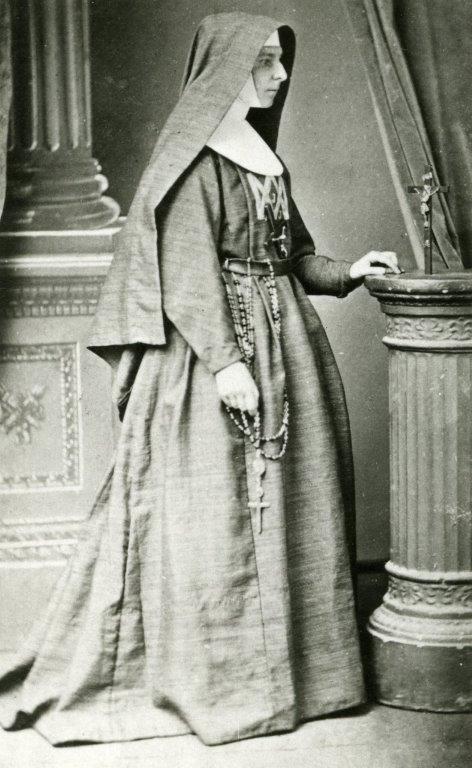
Within six months the way had become significantly clearer. In August 1866, Julian attended Bishop Sheil’s episcopal consecration in Melbourne. Soon afterwards he informed Mary: “I am appointed Director General of Catholic Education, Chairman of the Board and Inspector of Schools throughout the diocese.” [3]
He could scarcely contain his delight for now he was to have sole control of Catholic Education in the diocese and thus, had received, suddenly and completely, the means of establishing the religious for poor schools. [4] In his excitement the words tumbled from his pen and, although he was sad at having to leave Penola, the future held much promise.
Then, on 21 November 1866, Blanche Amsinck, a governess from Western Victoria, became the second woman to commit herself to becoming a Sister of Saint Joseph. Just after the New Year, she wrote to Mary:
There are two Sisters of St Joseph now, and we must pray most earnestly that God would increase our number. I do so long to be professed. … So, Mary, it rests with us, and oh! How I wish we were real Nuns. We have many obstacles to surmount before the Convent can be established but faith and prayer can remove mountains. [5]
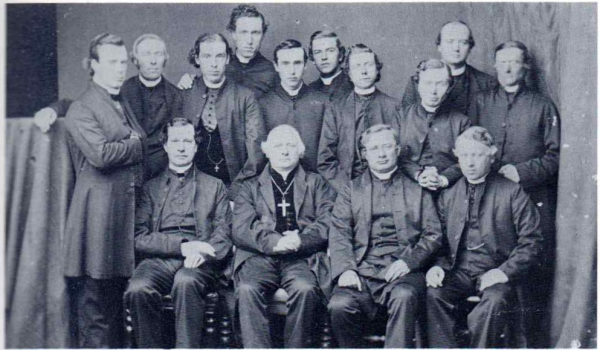
Mountains were moving for, within a week of Blanche’s writing, Bishop Sheil had tacitly approved the new foundation by addressing Mary as Sister. At once Blanche adopted the same title. [6] Little did they dream that further dramatic change was afoot!
Woods, who had moved to Adelaide in April 1867, soon realised that he needed Mary’s expert help in managing the schools. Then he faced a dilemma! As he announced that the Sisters of Saint Joseph were coming he realised that his Sisters, by this time all three of them, were not wearing an easily recognisable religious habit and did not have a written rule of life. [7]
Wisely, he left the decision regarding the sisters’ dress to these women, but he took full responsibility for drawing up their Rule of Life. According to his Memoirs, “it was written by him in a couple of days in May 1867.” [8]
He then sent it to his three Sisters, instructing them to copy it out in full and send him their copy. His reason—some of the clergy were throwing “deluges of cold water” on his idea and he did not wish to draw their attention to the fact the he was the one who had written this Rule. [9]
In late June, Mary and Rose arrived in Adelaide and undertook the management of the local Cathedral school. Parents were delighted and enrolment increased dramatically. Thanks to Woods’ enthusiasm, more young women joined the Institute. By the end of 1867, it had ten members teaching in three schools and managing a Refuge for women recently released from gaol. The future looked promising indeed!
On 17 December 1868, when the Institute had fifty members teaching in nine schools and managing three charitable institutions— a Refuge, an Orphanage and a House of Providence— Bishop Sheil approved Woods’ Rule for use in his diocese and agreed for it to be printed. Matters were moving much more quickly than any of them had ever dreamed.
Sr Marie Foale
Footnotes:
[1] The word Institute is used in this article because, during those foundation years of the Congregation of the Sisters of Saint Joseph it was, in fact, known as an Institute. The word Congregation was not used until many years later.
[2] Mary to the Sisters on the Silver Jubilee of the Congregation, 4 March 1891.
[3] Julian to Mary, 19 September 1866, Mary & Julian, Their Letters, 1862-1868, Trustees of the Sisters of Saint Joseph of the Sacred Heart, 1989.
[4] Julian to Mary, 19 September 1866.
[5] Blanche Amsinck to Mary from Mount Gambier, 3 January 1867.
[6] Mary to Julian, 2 February 1867.
[7] Their third member was Rose Cunningham who donned the black dress on 3 May 1867.
[8] Woods Memoirs, typescript copy without page numbers. One can only wonder how he managed to produce, by hand, a document of more than 7,000 words in a couple of days.
[9] Julian to Mary, 23 August 1866.
[10] Standing: L to R: Fathers Christopher Reynolds, Peter Hughes, Julian Woods, Michael O’Connor, Thomas Dowling, Theodore Bongaerts, Charles Van Der Heyden; Frederick Byrne, Simon Carew, Alois Kranewittcr SJ. Seated. John Smyth V.G., Bishop Lawrence Sheil, Josef Tappeiner SJ, Patrick Russell. Eight plus the bishop were Irish, five, including Julian Woods, were not.
Images provided by Sr Marie Foale. Used with permission.