

For the month of August, the Pope’s prayer intention is For evangelisation in the city and to“pray that in large cities often marked by anonymity and loneliness we find new ways to proclaim the Gospel, discovering creative paths to build community”.
For most of my life, I have lived in the city. Although I have also ministered in rural communities as a Sister of Saint Joseph, the city has always been my home. And so growing up, I never experienced a sense of loneliness or disconnection from others. Community flourishes in cities too – it can simply take a little more attention and effort to discover.
So, with the Pope’s intention this month for evangelisation, I look to his words in his Encyclical released in May this year: Magnifica Humanitas. Pope Leo XIV is commenting on the way in which the focus needs to be on the human person, particularly in response to Artificial Intelligence and how this is shaping our world.
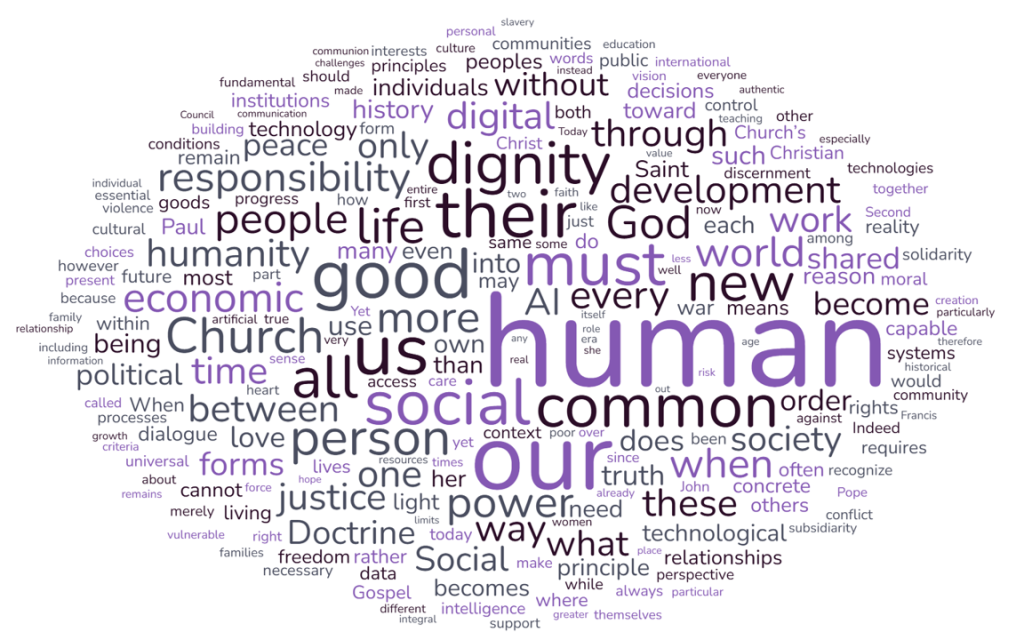
Five key points stand out for me, and which are reflected in the word cloud (above) are:
- Human dignity comes first. Every person is created in the image of God and possesses inherent dignity and worth. They should always be treated with respect and never reduced to a tool, a product, or simply a collection of data. (no. 73)
- Technology must serve humanity. Artificial intelligence should always remain under human moral responsibility, serving people and contributing to the common good. (no. 170)
- Truth and freedom must be protected. As a society, we must resist misinformation, manipulation, surveillance, and anything that diminishes human freedom, dignity, and the freedom of conscience. (no. 80)
- Work and relationships are sacred. Technological progress should enrich human work, strengthen family life, and foster thriving communities, always supporting these essential parts of our lives rather than replacing or diminishing them. (no. 133)
- Build a society of love. As Christians we are called to foster dialogue, justice, peace, and solidarity, ensuring that technology serves the human person and helps build a more compassionate, just, and humane world.
Now, don’t get me wrong, there might be a place for artificial intelligence, but it must not replace building personal relationships with each other. In my teaching I have used AI to help me to explain complex topics to younger students.
Our Holy Father invites us to pray and to discover new ways of proclaiming the Gospel, ways that respond to the unique challenges and hopes of life in our world, particularly in crowded cities.
In our world, where technology can connect us instantly yet leave us emotionally distant, the Pope insists that every person possesses an inviolable dignity because each is created in the image of God. (no. 58)
The first step is not necessarily preaching but noticing. It is learning the name of the café owner who serves our morning coffee. It is smiling at the lonely neighbour. It’s knowing the name of the cleaner in your school/office. It is making space for conversations after Mass. It is creating parish gatherings where newcomers are genuinely welcomed.
Every street corner becomes a place of mission. Every workplace, school, tram, train and shopping centre offers opportunities for simple acts of kindness that quietly reveal the face of Christ.
Evangelisation begins long before words are spoken. It begins when people experience the love, patience and hope of all of us.
As followers of Jesus, we are invited to become builders of community in a fragmented world. We are called to create places where people are known by name, where stories are heard, where differences are respected and where faith is lived with authenticity and joy.
Sr Rita Malavisi