
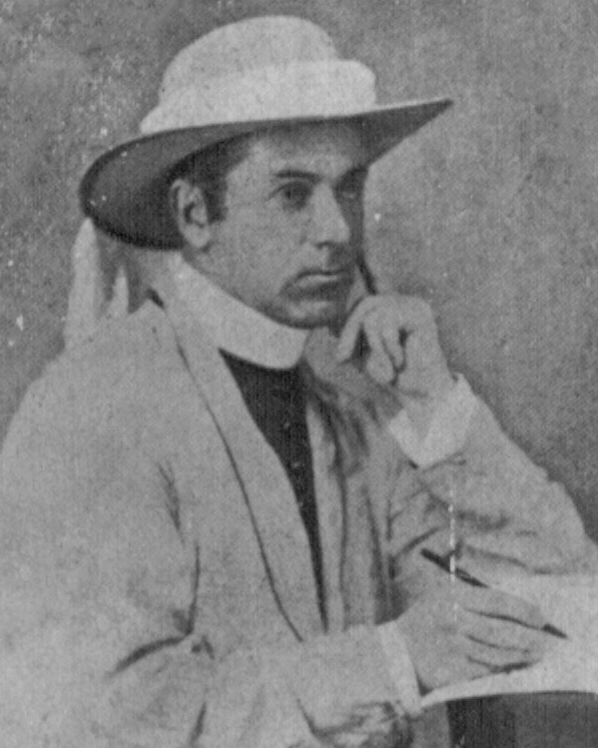
On 30 August 1883, the fifty-year-old Father Julian Tenison Woods first stepped ashore, on his way from Australia to Singapore, in the port of Banjoewangie (Banyuwangi) at the eastern end of Java. What can we learn about Fr Julian as scientist and traveller, as we remember him on 7 October?
As a natural philosopher, everything interested him. He did not fit into the increasingly specialised categories that mark science today. One of his many interests was volcanoes. Since encountering volcanoes and whilst a student in France, he maintained his interest.
In South Australia, there were volcanoes in the south-east. The Mount Gambier Volcanic Complex, Mount Schank, and the Newer Volcanics Province in Western Victoria.
Like travellers of today, in Java, Fr Julian visited the Ijen Plateau and Mount Bromo – much less comfortably though. Mount Semeru, which remains an active volcano, still erupting in 2025, was erupting as Father Julian watched. He also visited the area near the western end of Java, which had been devastated by the lethal Krakatoa eruption just before he arrived. While in Asia, our scientist visited volcanoes in Japan and twice visited Taal Volcano in the Philippines.
As a scientist, Fr Julian kept notes. These were the basis for extensive writings. An effective populariser of science, he wrote especially for the Sydney Morning Herald, which published three letters on “Earthquakes in the Straits of Sunda” in January 1884, and his “Journey Through Java” spanning twenty episodes to October 1884.
These notes also underpinned his research articles, especially after his return to Australia. The Proceedings of the Linnean Society of NSW, published his papers on the volcano Taal, and his extensive “Geographical Notes in Malaysia and Asia”, which included a lengthy section on Java. Fr Julian republished his “Geographical Notes in Malaysia and Asia” as the second paper in a series of “Malaysian Essays”, but his early death ended the projected series.
Occasionally we find newspaper reports of his talks, which drew on his scientific travels. In Australia, he had usually included a scientific talk in his local missions drawing good audiences. His talks benefited local charities or Church projects. In Singapore, he spoke about exploration in Australia, in Hong Kong about mining in the Malay Peninsula. While these talks mostly remained unpublished, the talk in Hong Kong was reported in full in a local newspaper revealing the humour and vibrancy of his talks, which is less evident in his scientific papers. Fr Julian was a great speaker.
Health was a major concern for Fr Julian. Outbreaks of disease were a recurring threat throughout his journey. In Java, he had to avoid three separate outbreaks of cholera – had he encountered these, he would have had to spend significant periods in quarantine. Indeed, one sickness seemed to him like cholera. But Fr Julian brought his own long-standing ailments. He was never fully well (though he would tell his ailing brother Terry that he was enjoying good health). Within the decade he had died.
An amazing traveller, an amazing scientist, and an amazing priest. We remember him on the anniversary of his death in 1889.
Fr Roderick O’Brien
The map of Java showing Fr Julian’s routes is part of the foundational work of Anne Player rsj. It may be found in her MA dissertation Julian Tenison Woods, 1832- 1889: the interaction of Science and Religion, and at page 22 of ‘Yrs Most Afftly’: Letters from Fr Julian Tenison Woods to Terry and Sarah Tenison Woods 1878-1887.
Fr Roderick O’Brien is a priest of Fr Julian’s Archdiocese of Adelaide. He recently returned from a visit to Java, and travelled partly in the footsteps of Fr Julian – without ever climbing a volcano.