
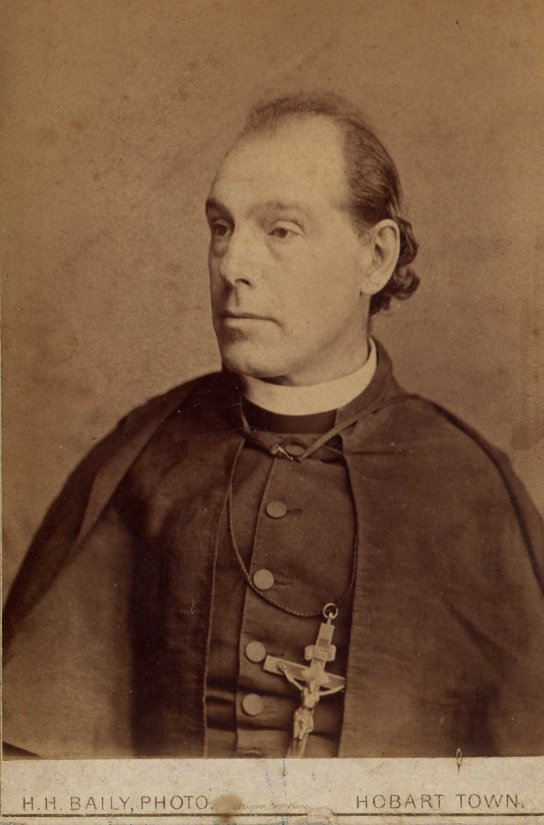
The months June to October 2026, mark the 140th anniversary of Father Julian Tenison Woods’ time in the Northern Territory. His death on 7 October 1889 occurred within three years of his leaving Darwin. Although his period in the Northern Territory was short, it calls for attention. What does it say about Fr Julian?
On 23 June 1886, Fr Julian arrived in Palmerston (later named Darwin) after three years in Asia pursuing his scientific work, undertaking pastoral ministry where possible, and enduring isolation and illness. His return had been delayed by war and outbreaks of disease.
He wrote to his brother Terry in Sydney and the Sisters of Perpetual Adoration in Brisbane to say he was leaving Darwin as soon as possible. He had not heard from Terry or the Sisters for six months. Correspondence with others also ceased at this time.
Fr Julian’s plan to leave was changed after an offer was made to him by the Government Resident to survey the Territory’s mineral districts. He told Terry that it was an offer ‘he could hardly afford to refuse’.
Before the survey offer, Fr Julian spent a few weeks on a supply ship, sailing up the Victoria River. He then left Darwin with the government survey party, and made the demanding trek of over 250 miles south, via other sites, to Katherine Telegraph Station. It was a taxing expedition. By the time of their return, ten weeks later, some of the party had fever. Fr Julian was almost blind. He had to cover his inflamed eyes with wet bandages. He had also received word of Terry’s worsening health.
After recovering enough, he wrote his Report of the Geology and Mineralogy of the Northern Territory. The 21,000-word report was completed in early October for transmission to Adelaide. [1] On the journey Fr Julian had taken notes, used later in Sydney for articles (dictated) for the Sydney Morning Herald and South Australian and Victorian papers.
His arrival in Darwin in June was reported in the newspaper, noting his expertise as a geologist. On the following Sunday, he celebrated Mass at the Catholic Chapel. He was then engaged by the Resident Governor for the geological survey. After returning from the Victoria River, he again celebrated Mass in the Catholic Chapel and the North Australian Newspaper advertised his coming lecture in aid of the ‘Roman Catholic Mission’.
The talk finally took place on 23 September after his return from the survey. The report of his talk, ‘Three Years Travel in the East,’ is reminiscent of his talk ‘Ten Years in the Bush’ on leaving Penola and his countless public talks where he had preached. The Northern Territory Times and Gazette noted ‘a most instructive lecture… the lecturer’s chatty descriptions… The rev gentleman handled his subject in a most simple and pleasing manner…he kept the audience thoroughly interested and amused.’ It was the same Fr Julian, with simplicity of manner, giving himself to uplift and entertain, with the funds going to others. It was his last fundraising talk.
Fr Julian celebrated Mass and preached ‘his farewell sermon’ at the Catholic Chapel on Sunday 17 October and left two days later for Brisbane. It was the feast of St Paul of the Cross, the founder whose order (the Passionists) Fr Julian had loved, but had to leave due to ill health at the age of twenty.
His time in the Territory was devoted almost entirely to his scientific work, yet all his work was grounded in his unwavering commitment as a priest. He accepted the demanding survey through care for his sick brother and family. Within a few months, his own health, never good, was deteriorating. His hands and limbs were swelling. Soon he could hardly hold a pen or walk.
********
On 23 June 1867, thirty-four-year-old Fr Julian was at Port Adelaide, eagerly waiting for Mary MacKillop and her companion from Penola. He was about to embark on the work that Anne Player named ‘the paramount involvement of his life, his work with the Sisters of St Joseph as their founder and director’.
Nineteen years later, on 23 June 1886, aged fifty-three, he arrived at the opposite side of the continent. He was recognised as a geologist, a priest, a priest who was a scientist, but no one hailed him as a founder. His greatest involvement was unknown or unmentioned. His period in the Northern Territory shows an exceptionally gifted, humble, and extraordinarily steadfast man, totally given for others as priest, brother, and scientist.
Jan Tranter rsj
Sisters of St Joseph Lochinvar
[1] Anne Player rsj noted it was the longest telegram ever transmitted on the overland telegraph line.
Sources:
- Roderick O’Brien, ‘Julian Tenison Woods and the Northern Territory’ in Julian Tenison Woods, a Pioneering Journey in Science and Faith, ATF Press, Adelaide, 2025.
- Anne Player rsj, ‘Julian Tenison Woods, 1832- 1889: the interaction of Science and Religion’. MA thesis, ANU, 1990
- Anne Player rsj, Introduction and notes, ‘Yrs Most Afftly’, Letters from Father Julian Tenison Woods to Terry and Sarah Tenison Woods 1878- 1887, Sisters of Perpetual Adoration, Brisbane, 2008