A 2026 National Reconciliation Week Reflection
I come from Goodooga in northwest New South Wales, from Yuwaalaraay, Yuwaalayaay and Gamilaraay Countries. From the black soil plains that remembers footsteps long before fences, borders and silence were placed upon this land.
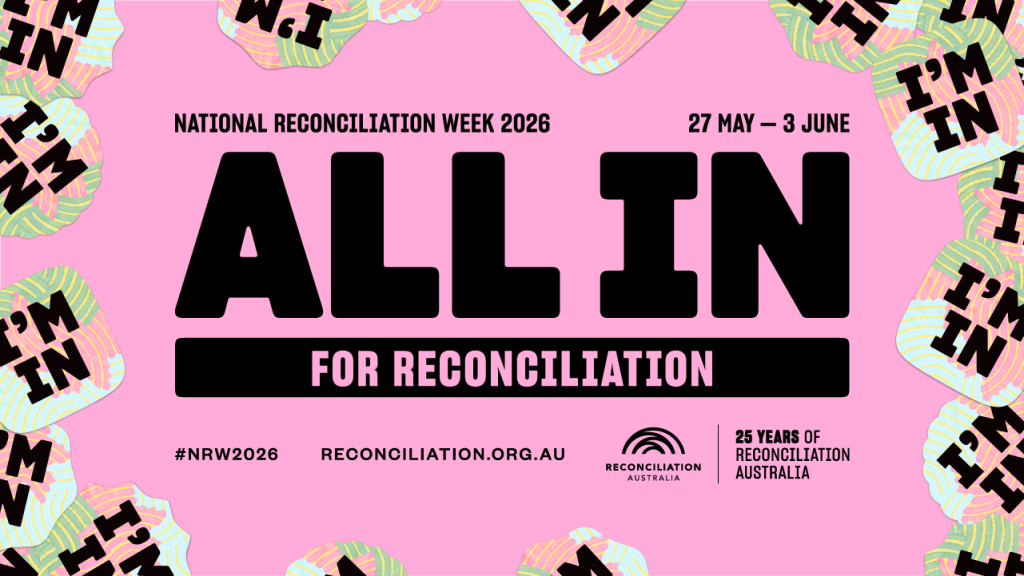
When I think about National Reconciliation Week 2026 (27 May – 3 June) and this year’s theme, All In, I do not hear it as a slogan.
I hear it as a calling.
A calling carried by the wind across Country. A calling whispered through the river gums. A calling spoken by Maran – by Ancestors who have watched this nation wrestle with truth for generations.
Because reconciliation was never meant to be comfortable. It was never meant to be symbolic alone. It was never meant to live only in speeches, acknowledgements or morning teas.
Reconciliation asks something deeper of us. It asks us to listen. To learn. To sit with truth. To walk together, even when the road is difficult.
The truth is that Aboriginal and Torres Strait Islander peoples have carried the weight of dispossession, exclusion, racism and intergenerational grief across generations and yet we are still here. Still singing. Still surviving. Still holding culture, language, kinship and spirit.
This is the miracle and strength of the oldest, continuing, surviving, living cultures on Earth.
The Uluru Statement from the Heart invited the nation into something sacred and profoundly generous. It invited Australia to walk with us in a movement of the Australian people for a better future.
Not above us. Not ahead of us. But with us.
That invitation still stands.
“All In” means every Australian has a role to play in answering that invitation.
It means moving beyond passive support into meaningful action. It means understanding that reconciliation is unfinished business. It means recognising that fairness is not always sameness. It means creating space for truth-telling, justice, healing and shared responsibility.
To be “All In” means we do not turn away when conversations become uncomfortable. We do not dismiss the impacts of colonisation as history that no longer matters. We do not leave the work of reconciliation to Aboriginal people alone.
Being “All In” means standing beside Aboriginal peoples and communities not only during National Reconciliation Week, but every week.
It means listening to local Aboriginal voices. It means supporting Aboriginal-led organisations and businesses. It means ensuring Aboriginal children see themselves reflected with pride, dignity and possibility. It means protecting Country because Country holds spirit, memory and life. It means learning whose Country you live on and understanding the stories held within that land.
“All In” looks like schools teaching honest histories. It looks like workplaces creating culturally safe spaces. It looks like governments listening deeply and acting courageously. It looks like churches, organisations and communities moving beyond intention into accountability.
Most importantly, “All In” looks like relationships. Real relationships. Built through humility, consistency, trust and walking together over time.
Reconciliation is not a destination we arrive at. It is a living practice. A daily choice. A collective responsibility.
And if we are brave enough to tell the truth about this country’s shared history, then perhaps we can also be brave enough to imagine a different future together.
A future where Aboriginal children grow up knowing their cultures are celebrated, not questioned. A future where justice is not conditional. A future where this nation learns that healing cannot happen without truth.
This National Reconciliation Week, may we each ask ourselves: What does being “All In” require of me?
Because reconciliation will not be carried forward by words alone. It will be carried forward by people willing to listen deeply, act respectfully, challenge injustice and walk together with courage.
And when enough of us choose that path together, this country begins to change.
Ways You Can Be “All In” During National Reconciliation Week 2026
- Learn the name of the Aboriginal Country you live, work or gather on.
- Read and reflect on the Uluru Statement from the Heart.
- Support Aboriginal-owned businesses, artists and organisations.
- Attend local Aboriginal community events respectfully and with openness.
- Read books, listen to podcasts and learn histories written and shared by Aboriginal people.
- Challenge racism, stereotypes and misinformation when you hear it.
- Advocate for culturally safe workplaces, schools and services.
- Build genuine relationships with Aboriginal colleagues, neighbours and communities.
- Create opportunities for Aboriginal voices to lead conversations and decision-making.
- Spend time on Country and reflect on your responsibility to care for land, waterways and community.
- Commit to learning beyond one week each year because reconciliation is ongoing work.
When we are all willing to listen, learn, act and walk together, we move closer to the future envisioned in the Uluru Statement from the Heart – a future grounded in truth, justice, healing and shared humanity.
Cassandra Gibbs-Smith
Reconciliation Action Plan Facilitator