
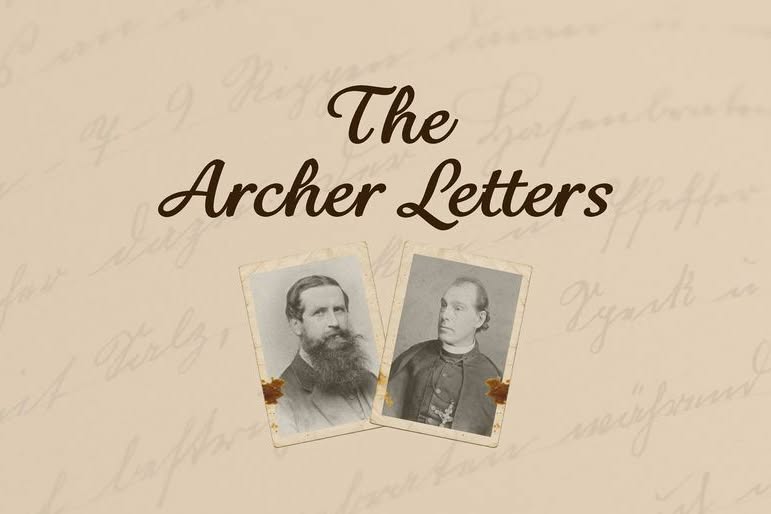
In 1980, Sr Anne Player [1] read 33 letters representing the exchange between Father Julian Tenison Woods (1832-1889) and William Henry Archer (1825-1909) over the years 1863-1889.
Anne realised that these letters gave a different glimpse of Fr Julian, situating him within Australian society of the time and revealing aspects of his life and interest apart from the Sisters of Saint Joseph. Anne set out to add comprehensive footnotes to the letters to give context and meaning and, with permission from the University of Melbourne Archives, in 1983, the Sisters of St Joseph, Goulburn, published The Archer Letters.
During his time in Penola (1855-1865), Fr Julian made at least four visits to Melbourne where he delighted to spend hours in libraries and bookshops. He visited his scientific friends and attended Royal Society meetings. It was at one such meeting that he began a firm lifelong friendship with William Archer.
William Archer was an English convert, a skilled statistician and actuary who had followed his family to Australia and married and settled in Melbourne. He drafted the Victorian system of legal and statistical registration of births, marriages and deaths and founded the Registrar-General’s Department. He was also a champion of Catholic education and received two papal decorations for his work in this cause. As an accomplished microscopist, he was eager to collaborate with others in the scientific field of discovery in this new country of Australia.
After the death of his brother, Edward, Fr Julian usually stayed with the Archer family at their home, Maryvale, in Hawthorn. The two found much in common both being English and sharing a passion for Catholic education and scientific research. [2]
Of the 33 letters, all except one are written by Fr Julian – that one is written by William Archer. They offer a valuable insight into the life and times of Fr Julian thanks to Sr Anne Player’s meticulous footnotes.
Sr Carmel Jones wrote an introduction to some of The Archer Letters in 2017 for the Mary MacKillop News eNewsletter. These introductions have been retained, but now all 33 letters are presented as one resource.
View all the letters in the series The Archer Letters below:
This letter from Fr Julian Tenison Woods to “My dear Sir”, William Archer, is rather a long one with a considerable number of explanatory endnotes. However, it is far from a tedious read!
Written from Penola towards the end of 1863, it is a good example of Fr Julian’s command of the English language, his fluent penmanship and his sense of humour. The letter from William Archer, to which he is replying, must have been an interesting one to have caused such a reaction! The endnotes, as compiled by Sr Anne Player, give valuable background to the people with whom Fr Julian associated in 1863 – and the scientific investigations that engaged his interest. He was, at this time, questioning the value of his membership of scientific associations as he was having trouble getting his writings published. However, the local papers seemed quite willing to publish his views. Riding around his far flung parish gave him ample opportunity to think about framing his next letter or article on whatever happened to be his current topic of interest.
Reading this letter, it is easy to imagine William Archer laughing aloud at some of Fr Julian’s remarks, particularly the references to having him prayed for publicly and being his horse! How much enjoyment can be had from a good friendship!
In a letter written from Penola on 5.4.1865, Fr Julian Tenison Woods writes to William Archer in a bantering tone. He will not be abbreviated with his words, as obviously William Archer had been in his letter of 21st!
Fr Julian’s sense of humour comes through, as does his praise of the work that William Archer is doing in the scientific area, despite his many responsibilities with the Government. He relies on his friend for resources and is keen to acknowledge him officially through naming a geological specimen after him.
In this month’s letter (16.5.1865) Fr Julian Tenison Woods writes to William Archer from Penola.
From it we get a glimpse into the number of people with whom Fr Julian had contact. He tells William Archer that he has responded to criticism from Fr Bleasdale, President of the Royal Society of Victoria and asks him to put in a good word in case he has offended him. He had, among other things, told Fr Bleasdale that he was working on overcoming his “youthful writing” day by day!
His enthusiasm for sharing his scientific knowledge seems boundless and he asks his friend, William, to support many ideas. We are left wondering what the busy William said after he read this letter!
On 1.6.65, Fr Julian Tenison Woods wrote to his friend, W H Archer Esq, from Penola. This letter perhaps proves what good friends these two really were because anyone else might have taken umbrage at receiving a letter in which most of the sentences are questions!
The letter does, however, accompany a hair specimen from an opossum mouse, requested by William Archer, so asking each other questions may not have been all that unusual at this stage when both were exploring the new country in which they found themselves. At least questioning was one way of getting the specific information needed when communication was dependent on the often irregular delivery of mail from place to place.
This is not only an entertaining letter but also gives an insight into the scientific work that Fr Julian was undertaking in between his parish responsibilities. He could always rely on William Archer to help him out. As he says, “I would not trouble you if I knew where to get them”.
The letter written by Fr Julian to William Archer from Penola on 5 September 1865, merits more than a cursory glance. It is, once again, full of questions and demands of his good friend but, as he says “Who have I to look but you?” He is grateful that William has recommended a microscope that will suit his purposes, and his pocket.
Written in free and easy conversation style, Fr Julian’s sense of humour here is at its best. He refers to his lack of means and suggests maybe the microscope could magnify his income! “The rule is that all priests say they are poor, the exception being in my case that it is true.” He asks for a book and suggests “get it anywhere – steal it – and tell me the cost to soul and body and I will remit in both senses!”
Fr Julian seems to be thriving on being busy about many things. His scientific interest has drawn criticism from clerical circles but that doesn’t seem to be weighing him down at the moment. Rather, he makes light of the situation in the Diocese of Adelaide (currently without a Bishop) by suggesting he might be the next to hold that office, or else he may be excommunicated!
Yes, this letter gives a wonderful insight into Fr Julian. William Archer probably laughed as he read it. I certainly did!
In a letter written from South Brisbane on 4.12.1873, we see for the first time Fr Julian Tenison Woods using the †JMJ sign at the beginning of his letters.
We also learn a little more of the Archer family (both the high and low moments of their life) and of Fr Julian’s time in Northern Queensland. He describes being ill from ague, a malarial disease consisting of fever, chills and sweating. Little wonder that he expressed the wish to spend summer in the cooler climate of Tasmania!
It is also worth noting that his signature is now “Father Julian” rather than “J.E. Tenison Woods”. There is a gap of seven years between the previous letter in this series, written from Penola on 24.11.1866, and this one. Much has happened in those years. Fr Julian is no longer director of the Sisters of Saint Joseph but has young women waiting to move to Brisbane to begin the Sisters of Perpetual Adoration. His contact with William Archer is now on a different level.
In his letter to William Archer on 12 October 1875, Fr Julian writes from Hobart where he seems to be busy about many things.
It seems Fr Julian had delayed answering William Archer’s last letter and had received, with both surprise and pleasure, a second one “tumbling in on the heels of the first”. As usual, there are requests to be attended to and views to share, particularly about plant life.
Fr Julian speaks of his role of caring for the Cathedral parish in the absence of Archbishop Murphy and one of his nephews, Archdeacon Beechinor. Yet, despite those important duties, he is classifying Tasmanian marine shells and getting papers ready to be printed.
There is light-hearted banter between the two correspondents around “Van Demons” and “lost tribes” and Fr Julian asks after Mrs Archer and the girls.
For the first time in this correspondence series, Fr Julian uses “Yours most truly in the Sacred Hearts” in his concluding phrase, words that he often used to sign off his letters to the Sisters.
This letter is the first to be written from Tasmania where Fr Julian spent considerable time between 1874 and 1876. Julian had already met Fr Daniel Murphy in London during his childhood. As Archbishop, Daniel Murphy had been involved in the Adelaide inquiry into the Sisters of Saint Joseph, after which Fr Julian accepted his invitation to give missions in Tasmania. No doubt he found life on the island a welcome respite from the dramas of life on the mainland.
Fr Julian is in the Huon district, south of Hobart, where he is giving a most successful mission. He mentions receiving 18 people into the Church and the footnotes give evidence of the esteem in which he was obviously held as an orator. The timber on which he recorded the number of communions and confirmations has been removed from the Geeveston church and is now on display in the Julian Room of the Mary MacKillop Spirituality Centre, Josephite Mission at New Town, Hobart.
In his letter of 6.1.76, Fr Julian says he is enclosing a cryptogamic puzzle. Obviously he forgot to do this because the purpose of his letter of 22.1.76 is now to send the Fungus! The two letters allude to his involvement with the Tasmanian Royal Society whose monthly meetings both stimulated his scientific work and gave him a forum for sharing his reading and research.
This letter is to Mrs Archer, apologising for once again being delayed in his visit and asking for assistance for one of the women from a community he was trying to establish. This letter shows the esteem and trust in which Fr Julian held the Archer family. It is little wonder he enjoyed spending time at their home.
What is not mentioned is the reason for his delay in leaving Tasmania – he was, around this time, quite ill. In fact Fr Julian did not leave Tasmania until November 1876, a further delay occurring when Bishop Murphy asked him to take charge of the Oatlands parish for several months. He finally spent time with his good friends in January 1877.
In this letter, Fr Julian expresses his appreciation for the enjoyable time he had spent with the Archer family the month before. He is now in Sydney en route to Bathurst.
Fr Julian describes the ship, the Wotonga, in which he journeyed from Melbourne to Sydney as “one of the very best boats you can travel in”. Maybe this was because it was relatively new, only built in 1876. The Wotonga was owned by the Australasian United Steam Navigation Company in Sydney but was wrecked on rocks off Port Macquarie on 2 January 1882. A very descriptive newspaper article about the wreck can be found in the Maitland Mercury and Hunter River General Advertiser on Tuesday, 10 January 1882, page 3: http://trove.nla.gov.au/newspaper/article/846157/38505
In this letter Fr Julian speaks candidly about church personnel in Sydney – his scientific interests hardly rate a mention. It sounds as if he has been busy about more social pursuits.
This letter is written in the midst of a busy time for Fr Julian. Obviously the period between Christmas and the middle of January was a popular time for priests and religious to be on retreat and Fr Julian was much in demand as a retreat director. No doubt the retreat experience would have involved several talks each day over six or eight days. The timetable would have been structured around daily Mass, recitation of the Divine Office and other prayer devotions.
In the midst of the busyness, Fr Julian had found time to write a scientific paper on Corals. No wonder he wistfully remembers that, twelve months before, he had been rambling in the mountains with the Archer family. Now the memory is cause to remark that maybe, one day, when life slows down for good, they will all be rambling again in the beautiful fields of heaven!
It is interesting to note that Fr Julian was a member of the exclusive Australian Club in Sydney and certainly was a regular visitor there during 1878. This suggests that he was comfortable being with people no matter their religion or rank in society. Wherever he travelled, he also remained interested in his own extended family.
Once again, we are given a fascinating glimpse of a man of many activities…
There has been a delay in Fr Julian receiving Sir William Archer’s letters due mainly to confusion over the address at which Fr Julian’s mail is held while he is absent from Sydney giving missions in remote parish areas. It is interesting to note Fr Julian’s membership of two clubs in Sydney, the Union Club and the Australia Club. He was obviously held in high esteem here, in contrast to the wariness he felt among his fellow priests!
Despite his travels, Fr Julian is obviously keen to write papers from his notes and observations in Tasmania, and elsewhere, and also to read these papers at the Linnean and Royal Societies. He stresses the importance of research work being done in the local area as conditions in Australia are unbelievably different from any that scientists in England have yet come across.
Fr Julian also refers to Sir William’s career in the Civil Service being abruptly terminated on 8 January 1878, when he was one of the large number of public servants summarily dismissed by the Berry Government.
Sr Anne Player explains the political situation in Footnote 1 of a letter that Fr Julian wrote to Sir William from Lambton, Newcastle on 29.1.78:
Sir Graham Berry (1822-1904) migrated to Victoria in 1852 and engaged in trade and journalism before turning to politics in 1860. A radical, his career as politician was varied but in 1877 he won an overwhelming victory at the general elections and became Chief Secretary and Treasurer. Because his party was largely lower-middle-class, Berry needed to have the renewal of payment of members passed by both Houses. There were indications that the Legislative Council would oppose this, so the payment of members was tacked on to the Appropriation Bill. Passed by the Assembly, but blocked by the Council, Berry retaliated by publicly announcing through a Government “Gazette Extraordinary” of Wednesday, 8th January, 1878 (“Black Wednesday”) the dismissal of all persons then holding the office of Judges of County Courts, Courts of Mines and Insolvency; all chairmen of Courts of General Sessions; all Police Magistrates, Coroners and Wardens of Goldfields; the Engineer-in-Chief of Railways; a large number of executive heads of important departments and about a hundred subordinate but mostly well-paid officials. Officially this was justified as necessary to conserve funds, but several leading radicals, including Berry, spoke of it publicly as revenge on the members of Legislative Council through their friends in government. (A.D.B., Vol. 3, pp. 151-156).
(See also C.M.H. Clark ‘’A History of Australia” Vol. IV, Melb. Uni. Press, 1980. pp. 264-270)
“Archer was a victim of these dismissals and from that time on had no regular employment. His attempts to establish himself first in the political, then in the legal world met with failure, as did his candidature in 1881 for the librarianship of the Public Library”. (University of Melbourne Archives, General introductory note to William Archer Papers.)
Fr Julian is confident that all will work together for good eventually and promises to remember his friend daily in prayer.
This letter tells the reader much about the place of science in the life of Fr Julian. He loves all things scientific but he is always a priest first, attending to his many ecclesiastical duties before spending time pursuing scientific interests – writing papers, visiting museums or taking notes while rambling. At this time Fr Julian is giving a mission at Morpeth, saying Mass, preaching to adults and to children, hearing confessions and leading the evening service each day.
This letter also gives us an idea of the scope of Fr Julian’s scientific writings. To see them listed in his own words and then to read the endnotes compiled by Sr Anne Player, seems to prove what a remarkable man Fr Julian was for his times. He is passionate about his vocation and finds in science an interest that enhances his life as a priest.
In his letter of 18 October 1883, we find that Fr Julian Tenison Woods is now in Singapore, having left Brisbane three months before. He relates wonderful new experiences, including witnessing volcanic activity and declares “I shall never forget my journey!” He was, of course, a guest of the Governor, Sir Frederick Weld, a friend from his years in Tasmania. He now looks forward to travelling with him to explore and geologize as long as there is anything to examine. There will be time along the way to say Mass at various Catholic missions.
Fr Julian begins this letter to Sir William Archer with an apology for not writing before he ran off to Asia. However, when we read how many articles he had published in 1883, we can see what has preoccupied his time and thoughts. He ends as he does on many occasions – asking Sir William to write to him, this time direct to Government House in Singapore.
Fr Julian’s travels have begun on a cheerful note. However, as we will see in further letters written from Asia, his feelings of being well and strong do not last.
Fr Julian is now some months into his travels in Asia. It seems that his health had been good from August 1853 until the beginning of January 1884, despite the fact that he had endured uncomfortable boat trips and others around him succumbing to jungle fever. However, he did get fever in due course and suffered so considerably his doctor advised him not to stay in the country too much longer.
Fr Julian’s opinion of the country is not all that high! He shakes his head at the living conditions, the huge challenge of paganism and the tigers prowling at night.
Throughout this letter, as on so many other occasions, Fr Julian’s sense of humour remains strong – as does his desire to hear more from his friend, William Archer. It must have been an uplifting experience for him to receive news from Australia and his desire for Archer to fill in the gaps around what he had heard leads him to say “write soon and write long”. Ways of communication were far removed from our experience today – imagine how long it would have taken a letter to get from Singapore to Melbourne and vice versa.
Yet again, this letter tells us much about how Fr Julian coped with life.
Wherever Fr Julian went he found people who had connections to Australia. In this letter he mentions that he was staying with Sir George Bowen, a former Governor of Victoria (1872-1879). It seems Fr Julian was not too charmed by Sir George because of the introduction he had given to his lecture on mines and minerals in the Malay Peninsula!
Fr Julian describes to his friend, William Archer, some aspects of the interesting voyages he had experience on HMS Pegasus travelling around Borneo, the Philippines and China and, in so doing, gives us a glimpse of the missionary efforts of the church in this area of the world at this time. How different this world was from the one Fr Julian to which he had become accustomed in Australia! But, as he says, he could still be a little use, even there. Once again, Fr Julian’s way with words and sense of humour captivates the reader.
This letter was written from the mountains behind Osaka in Japan.
Fr Julian had retreated here to indulge his love of botany, geology and solitude. He seemed to be quite intrigued with Japan, its houses and people and was only too happy to be confined here longer than he expected due to a cholera epidemic “in the plains below”.
It is obvious, once again, that Fr Julian values being able to share his thoughts with William Archer, even if postal arrangements don’t always deliver his sporadic letters!
Fr Julian’s travels have been extensive – the Philippines, Cochin China, Singapore, Penang – and he had explored with great satisfaction, even though at times his living conditions left much to be desired. He is quite content wandering from country to country and, despite being poor, he wants for nothing. Interestingly, he attributes this to confidence in Mary, Mother of God.
This letter shows Fr Julian’s wonderful command of the English language and his sense of humour but it also gives us a glimpse into a life where scientific and religious practices intermingle. Fr Julian obviously enjoys travel, exploration and making notes, but he is also committed to saying Mass, baptising people and trusting in a higher realm.
This is a letter to be read slowly and to enjoy. It gives context for many articles that Fr Julian later wrote.
This letter is written from William Archer to Fr Julian Tenison Woods welcoming him back to Australia in 1886. It is Archer’s only letter in this collection.
Written from his home in Melbourne on the feast of Corpus Christi, 1886, William Archer’s words are warm and inviting – in anticipation of seeing his good friend once again. He is eager to hear all about Fr Julian’s research and to encourage him to speak and write about his experiences.
This letter gives us a glimpse of how highly Fr Julian was regarded by his peers. William Archer could assure him that “all” would welcome him back. Word that he was on his way laden with specimens of natural history held the promise, no doubt, of many interesting debates.
Fr Julian’s heart must have been warmed when he received such enthusiasm about his return.
Fr Julian Tenison Woods’ letter to William Archer on 3 January 1888 from his home in Elizabeth Street, Sydney, was probably not penned by himself. However, he did add his own signature.
The reason for not writing himself was a serious deterioration in his health, leaving him an invalid unable to use his hands and feet freely. His eyesight was also failing. Yet, despite all this, Fr Julian was continuing to work from his travel notes and prepare articles and scientific papers. His able assistant was Anne Bulger, to whom he had also dictated his Memoirs. (Anne was a member of the lay community of devoted women who cared for Julian in his final invalid years.)
This letter portrays a man determined not to be overcome by his physical disabilities. Fr Julian’s mind is alert and active and, despite all, he is still able to very successfully get his thoughts on paper.
Fr Julian describes his brother, Terry, as having had his purgatory in this world – maybe the same words apply to himself. We see a man of suffering trapped in a failing body yet still able to live as fully as he possibly can – he does not feel imprisoned and his tone is cheerful.
William Archer may well have treasured this letter.
This short letter, written on 22 March 1888 from Fr Julian Tenison Woods in Sydney to William Archer in Melbourne is not written in his own handwriting. Anne Bulger has penned his words, although Fr Julian does attach his own signature and love and blessings to Mrs Archer and Gracie.
The letter is accompanied by the first instalment of a paper on the Volcano of Taal written from his Asian travel notes.
The last letter in this series was dictated by Fr Julian Tenison Woods on 13 March 1889. It reads as if maybe he knew it would probably be his last effort to his dear friend, William Archer.
The tone of the letter is one of resignation to his state of health with little hope of relief, but he remains cheerful and happy and expresses his determination to continue as such to the end. His work of dictating notes for publication has ceased – even letter writing is trying, although he is still eager to receive letters!
This is a grand letter to conclude The Archer Letters series! I believe it shows the strong spirit of a well-respected man:
- a man of deep faith (“Resurgam”) whose trust in the Sacred Hearts of Jesus and Mary and love of St Joseph remained with him to the end – as did his faithfulness to reading the Scriptures.
- a humble man who asked his good friend to “Pray for me”
- a man of words – a well respected writer of scientific articles
- a man who valued his vocation as “Father” Julian.
When I combine these qualities with the other side of his life as spiritual mentor to the young Mary MacKillop and co-founder of the Sisters of Saint Joseph, I can only feel very glad that my life has been enriched through meeting him through his words.
Fr Julian said “God bless you my dear Archer.”
I say “God bless you my dear Julian.”
Carmel Jones rsj
Footnotes:
[1] Sr Anne Player, a Sister of St Joseph from Goulburn, was keenly interested in history and science. She completed her MA thesis Fr Julian Tenison Woods, Priest and Scientist, at the Australian National University and was passionate about research into Fr Julian’s life and times. Anne died in July 2016. The Sisters of Saint Joseph are grateful for her legacy which ensures that Fr Julian is better known and understood.
[2] Information from Margaret M Press ‘Julian Tenison Woods: Father Founder’ (2004, Collins Dove) and Cecily Close, ‘Archer, William Henry (1825-1909), Australian Dictionary of Biography (1969, Australian National University)