
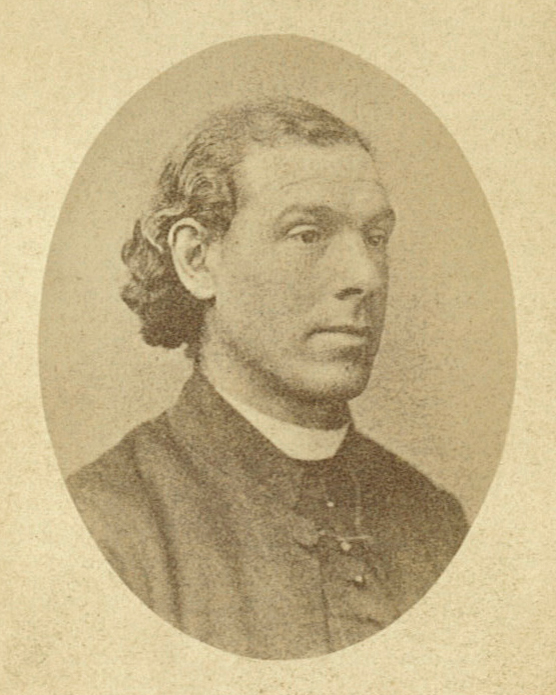
Julian Tenison Woods, whose death anniversary occurs on 7 October, had a friend named William Henry Archer (1825-1909), and we can glean from some letters from Julian how famously these two men got along.
Archer became a Catholic in 1848. That was the time of the Oxford Movement, where a number of Anglicans became Catholics. Cardinal Henry Newman is a notable one, and others included Robert Hugh Benson (books), Frederick William Faber (hymns), Gerald Manley Hopkins (poems), Ronald Knox (the Bible).
Archer sailed to Melbourne in 1852, gaining employment as Lands and Survey Secretary in the Victorian government, followed by other similar positions. His Catholicism did not endear him to all, and his growing electoral ambitions were generally not achieved. During his long retirement he engaged in scientific and linguistic studies, in painting, sculpture and other hobbies, all feeding his friendship with Julian Tenison Woods.
Thanks to Sister Anne Player, we have access to a number of the letters which Julian wrote to William entitled, The Archer Letters. Anne’s remarkable scholarship is so careful and complete, gifting us with a collection that is historically sound and highly accessible. Click here for the version on the Australian Catholic University website and here for the one on the Sisters of Saint Joseph website.
Julian Tenison Woods is pivotal to the existence of the Sisters of Saint Joseph, of course. We have some familiarity with his life history, his many skills, his desire for the education of the children and his commitment to God.
The Archer Letters give a glimpse into Julian’s life and wide concerns. They show that he shared with William a fascination with the natural world of Australia, interspersed with his concern for Archer’s wife and growing (and sometimes dying) family.
The Archer Letters also give us insights into a friendship. They show Julian’s wit, as well as his engrossment in subjects of value, couched in language that attests to an easy, trusting relationship. The first sentence in the first letter of the collection, reads:
If you write me any more of those stiff epistles, smattering of quakerism, heresy and what not I shall have you prayed for publicly in the church.
He goes on:
… let me remind you that no man ever became eminent in science unless ‘through hard and rough times’ and if you think I have nothing else to do, I wish as a punishment that you were my horse for a month.
On 5 April 1865, Julian wrote: “I would have answered your letter sooner but I only came home yesterday from a tour of 18 days in killing weather, with precious little meat, and yet having to provide refreshments for the fleas of about 12 shepherds’ huts.”
A little later: “The rule is that all priests say they are poor, the exception being in my case that it is true.” (5.9.1865). He followed that on 14 September with, “I am hugely enamoured of binoculars having never seen one, and both of my eyes being weaker than the other!”
Many of the letters end with “Vytryyrs” which means “Very truly yours”, no doubt a usual device in those days, but which may seem odd now. Nevertheless, Julian’s long friendship and shared interests with his friend is well expressed in that phrase.
The same can be said for Julian’s past and present relationship with us. There is a strong historical and religious mutual ownership present where we acknowledge the fundamental necessity of this man to our existence and charism as Josephites, and where he undoubtedly looks on us, and smiles.
Susan Connelly rsj